Pardalote Holt

Pardalote Holt
The centre of it all

Sunday, May 3, 2015

What happened to March?

A tad late, but here's what happened in March. March is the start of Autumn in SE Queensland and starts the change from the wet to the dry season. It's also a lot cooler (or supposed to be). This is one of the transition periods as far as birds are concerned and a lot of the smaller birds are beginning to show their faces. There are also a lot of juveniles around. Birds that hatched in the summer and are now really finding their own wings, in particular we've had a pair of juvenile Little Friarbirds and a pair of juvenile Spangled Drongos that seemed to have joined up to form a fun foursome and we'd often see them chasing each other around the grounds or having a dip in the Lap Swamp when it was time for a wash and brush-up.  Both species seem to wash by flying down to the water and briefly dipping in with a splash before flying back up to a branch for some serious preening. They are joined in this method by a range of species including Rainbow Bee Eaters (who make a complete ballet over the whole process), Yellow-faced and White-throated Honeyeaters and Grey Shrike Thrush. I have been desperately trying to get some images of this, but as yet without luck as it all happens so fast, but I will persevere.

My interest in birds still dominates, but partly due to the Mount Tamborine Wildlife Pics Facebook page I have started taking photographs of other things, and I'm sure you will have noticed Dragonflies and Butterflies in previous posts, but today it's spiders! Living in the bush you have to get used to spiders, they are everywhere, and they love to set up home around the house and so I have a constant war with them, but, when you stop and take notice of them some are quite stunning (and yes, some are also very creepy!)

St Andrews Cross Spider

The St Andrews Cross Spider is commonplace and quite colourful. I'm unsure as to whether they've named the spider because of the way it sits, or because of its web which commonly sports a cross woven slightly thicker than the rest of the web. Two 'spines' of the crossed web can be seen here at 5 o'clock and 11 o'clock.

Jewelled Spider
 A real stunner this little fellow. About the size of your pinky finger nail the Jewelled Spider sits in it's web awaiting prey. I've been watching this one for some time now and it's still in the same place some 7-weeks after I took these photos despite a couple of storms and a severe rainfall event.


Jewelled Spider

 Moving into the creepier range is the Grey Huntsman that can grow to the size of your hand and is common in the bush around these parts. Fortunately it isn't a web builder, it's a rover, and despite the size is quite timid.

Grey Hunstman

 The Brown Huntsman can grow to a similar size and hunts across ceilings and walls, but he's a lot more aggressive and a ready biter.
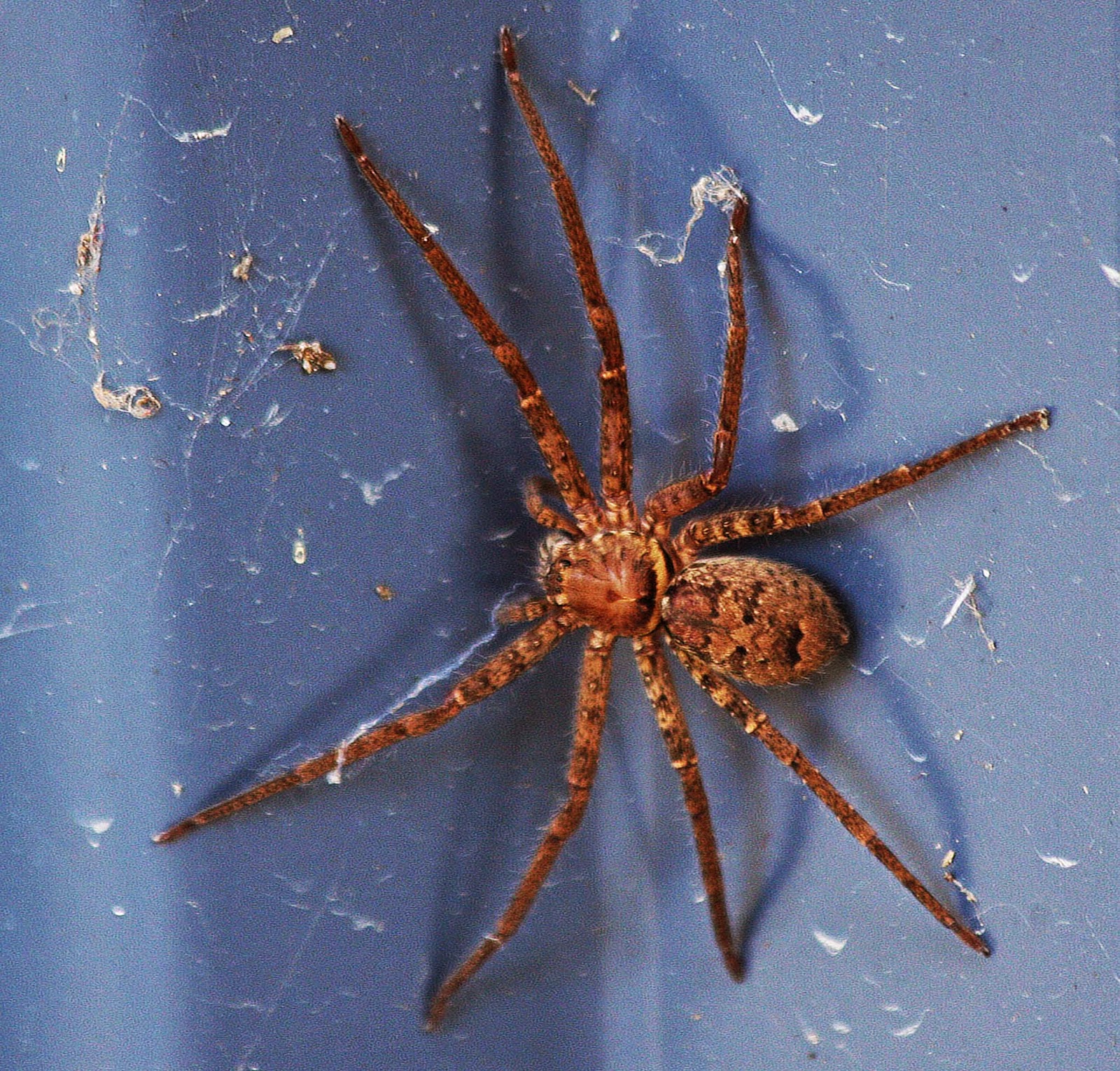
Brown Huntsman

The Golden Orb-weaver Spider is a biggie, growing to palm size and building webs of over a metre in diameter and these are strong, strong enough to catch small birds such as Silvereyes. They are very common in the bush and fortunately, their golden webs are fairly easy to see.

Golden Orb-weaver
Right, I think that's enough of putting people off coming to visit. Let's move on to all things cute and pretty.  This month we had our very first family of Plumed Whistling Ducklings appear on the dam, and to our delight they have stayed and not moved off as many of the other ducks do. I make no apologies for posting a number of photos of the ducklings, they're just so darned cute!


The ducklings first appeared covered in stripes.

It wouldn't be for another three weeks that their plumage began to change.

Their parents were very attentive.

Which was good as occasionally the ducklings could be quite noisy.

I just love 'em!
Further pictures of the ducklings will appear in the following posts as they move towards maturity.

The ducks are the only ones with young at this time of the year, the Red-necked Wallabies are aslo carrying young Joeys. Not big enough to be bouncing around yet, but certainly enjoying a chance to stick their heads out of the pouches and start exploring the world.

Red-necked Wallaby and Joey.

 
Another (possibly the same) Mum and her joey.

And on to the birds....

Regulars  (seen at least 5 days in the week)

Australian Magpie
Bar-shouldered Dove
Bronzewing
Brown Honeyeater

Brown Honeyeater in the Grevilleas.

Double-barred Finch

Double-barred Finch at a feeder

Galah
Noisy Friarbird
Pacific Black Duck
Peaceful Dove
Plumed Whistling Duck
Rainbow Lorikeet

Rainbow Lorikeets over the feeder.

Spangled Drongo

Juvenile Spangled Drongo

Striated Pardalote


Striated Pardalote


Sulphur Crested Cockatoo
Torresian Crow
Welcome Swallow
White-throated Gerygone
White-throated Honeyeater


A family of White-throated Honeyeaters.

Yellow-faced Honeyeater


Common (Seen at least twice a week)

Black-faced Cuckoo Shrike

Black-faced Cuckoo Shrike

Black-faced Monarch


Juvenile Black-faced Monarch.

Grey Shrike Thrush
King Parrot
Laughing Kookaburra
Leaden Flycatcher


Female Leaden Flycatcher

Little Corella
Little Friarbird


Little Friarbird in a Wattle.

Noisy Miner
Pale Headed Rosella
Pied Currawong
Rainbow Bee Eater

Rainbow Bee Eaters enjoying the late afternoon sun.

Rufous Whistler

Female Rufous Whistler


Uncommon (Seen two to five times during the month)
Blue-faced Honeyeater

Blue-faced Honeyeater in the Robyn Gordon Grevillea.

Brown Cuckoo Dove
Collared Sparrowhawk

Collared Sparrowhawk takes wing.

Eastern Yellow Robin
Forest Kingfisher
Grey Butcherbird
Magpie Lark
Olive-backed Oriole
Pied Butcherbird
Red-backed Fairy Wren
Red-browed Finch
White-bellied Cuckoo Shrike
White-throated Treecreeper
Willie Wagtail
Yellow-rumped Thornbill
Yellow-tailed Black Cockatoo

Rare (Seen only once)
Australian Ibis

Australian Ibis in a large gum tree.

Azure Kingfisher
Brown Goshawk

Cicadabird
Crested Pigeon
Dollarbird

Eastern Whipbird
Grey Shrike Thrush
Lewins Honeyeater
Magpie Lark
Masked Plover
Rufous Fantail
Scaly-breasted Lorikeet
White-faced Heron
Wedge-tailed Eagle
White-headed Pigeon

Which is 63-species, down two species from 2014, but up eleven from 2013. The noticeable absence are the Wood Ducks that where here throughout March in previous years, but I suspect that they've been displaced by the Plumed Whistling Ducks.

See you next month.  Cheers.

Monday, March 30, 2015

February comes and so do butterflies and birds.

The seasons in Australia are a bit fluid. In the temperate zone (down south) you have the traditional four seasons of Spring, Summer, Autumn and Winter, whilst in the tropics of the north you have two, the wet and the dry seasons. In the sub-tropics, which on the east coast means from Cairns in the north to the northern end of New South Wales in the south it's all a bit hazy, but February is supposed to be the last month of summer and still within the confines of the wet season.  Well, we in Guanaba on the foothills of Mount Tamborine (meaning the Hill of the Figs, nothing to do with the percussion instrument) had both. In other words it was quite hot and quite wet.  Trust a Brit to begin with a piece on the weather!

A combination of the rains and a desire to leave the nesting swamphens undisturbed limited my gardening activities at the Holt to fussing over the chooks and just generally watching everything grow and grow. By the end of the month the grasses were beyond waist height and several species of vines were threatening to strangle a number of innocent shrubs. A perhaps unexpected effect of the vigorous profusion of vines was a large rise in butterfly numbers and during much of the month we were treated to large numbers of some rather beautiful butterflies flapping around from bush to vine. In particular the striking Blue Tigers were commonplace, as were the much larger, but very difficult to photograph Orchard Swallowtails.

Blue Tigers on a Monkey Tail Vine

Hard to capture the numbers, but at one point there were over 30 on this vine alone

Gorgeous insects

A pair of Meadow Argus mating on the driveway.
Caterpillar of the Black Crow beginning to go into chrysalis phase.

"Up we go!"

An elegant Black Crow butterfly.

An Evening Brown, very frustrating as they invariable close up when they land.


The elusive Orchard Swallowtail.


A small Blue

The female Common Eggfly resting on a tree fern frond.
Of course it was probably the increase in butterflies, caterpillars and bugs in general that fed the massive number jump of species this year. Up sixteen species on the same moth last year!

The wet weather certainly helped and a couple of times we had real downpours, which at the time weren't so popular with the birds!

The Rainbow Lorikeets were looking for the rainbow.

Sparky the King Parrot just sat it out.

But it was a good excuse for some blissful grooming.


and of course all the rain brought out more toadstools...

Creamy coloured toadstools erupting from the gum mulch.

I have planted various grevilleas so that they almost butt up against the back deck and they never fail to supply a succession of small birds for me to admire, but towards the end of the month I got a real treat.  A movement caught my eye and this time it was the small and graceful Green Tree Snake.


Just one gorgeous little snake.
Well, with so much to see there was only so many photographs I could take, but I hope you enjoy them.  Now onto the bird lists.

Regulars  (seen at least 5 days in the week)

Bar-shouldered Dove
Bar-shouldered Dove

Bronzewing

The Common Bronzewing living up to his name.

Galah

The rare sight of a Galah trying to be serious.

King Parrot

A juvenile male King Parrot

Olive-backed Oriole

A juvenile Olive-backed Oriole

Pacific Black Duck
Peaceful Dove

Peaceful Doves having a good preen.

Plumed Whistling Duck

The extremely pretty Plumed Whistling Duck

Rainbow Lorikeet
Spangled Drongo
Sulphur Crested Cockatoo
Torresian Crow
Welcome Swallow

Welcome Swallows roosting in the garage.

White-throated Gerygone
White-throated Honeyeater

White-throated Honeyeater after nectar in the grevilleas.

Wood Duck

Mom Wood Duck takes a drink whilst the ducklings gossip.

Yellow-faced Honeyeater


A Yelloe-faced Honeyeater in another grevillea.


Common (Seen at least twice a week)
Australian Magpie
Black-faced Cuckoo Shrike
Brown Honeyeater

A Brown Honeyeater

Double-barred Finch


Double-barred Finch in the feeder.

Grey Shrike Thrush

A Grey Shrike Thrush hunting bugs by the deck.

Laughing Kookaburra
Leaden Flycatcher

An elusive, but pretty female Leaden Flycatcher.

Little Corella

Little Corellas at the feeder.

Noisy Friarbird
Noisy Miner
Pale Headed Rosella
Pied Currawong
Purple Swamphen
Striated Pardalote


"Chup-a-chup" the Striated Pardalote

Uncommon (Seen two to five times during the month)
Blue-faced Honeyeater
Brown Thornbill
Channel-billed Cuckoo
Cicadabird
Eastern Whipbird
Eastern Yellow Robin
Forest Kingfisher
Grey Butcherbird

A Grey Butcherbird positioning to steal the cat food.

Little Black Cormorant

Little Black Cormorant drying his wings after a dip in the dam.

Little Friarbird
Magpie Lark
Red-backed Fairy Wren
Red-browed Finch
Rufous Whistler
A female Rufous Whistler

Shining Bronze Cuckoo
Variegated Fairy Wren
White-bellied Cuckoo Shrike
White-headed Pigeon
White-throated Treecreeper
Willie Wagtail

A Willie Wagtail singing for his supper.

Yellow-rumped Thornbill

A Yellow-rumped Thornbill.

Yellow-tailed Black Cockatoo

Rare (Seen only once)
Black-faced Monarch

The shy Black Faced Monarch.

Brown Cuckoo Dove
Brown Goshawk

An immature Brown Goshawk disturbs the peace.

Brush Cuckoo

An immature Brush Cuckoo

Collared Sparrowhawk
Little Pied Cormorant
Rainbow BeeEater


The grace of Rainbow BeeEaters arriving for Autumn.

Scaly-breasted Lorikeet
Varied Sitella

A personal favourite, the Varied Sitella

Wedge-tailed Eagle
Weebill


Which is 67-species, up a massive 16 species from last year and March is looking good as well. See you next month.  Cheers.