We are all many things, gems with different facets, and one facet of my life is pretty obviously birds. To say it is just birds would be incorrect as I've always had a fascination for nature in general, but my passion for birds perhaps rises above the rest. Many people who have noted my affection for winged things have referred to me as a Twitcher and that isn't quite right. Billie Oddie, the short bearded comedian who was part of the Goodies (for those of us who can remember back that far) wrote his excellent 'Bill Oddies Little Black Bird Book', a well thumbed copy of which nestles comfortably between various bird identification guides in our library. Bill, a self confessed Twitcher, takes time in his book to cover the various terms that Twitchers use and in particular gives broad definitions of the various types of people who enjoy birds. I will briefly paraphrase his work, but would thoroughly recommend that you seek out a copy of the book yourselves. If nothing else it's an amusing read.
 |
| A vital part of a Birder's library. |
Firstly lets get rid of some of the older tags such as Bird-spotter or bird-fancier. Well the latter more normally refers to someone who keeps, breeds and shows birds. Birds such as pigeons or fancy poultry and although I keep chickens that's hardly a reason for me to fall into that category. As for bird-spotters, well it's a silly word, I'm going bird-spotting...spot,spot, spot; no, that just won't do at all. Well how about Ornithologist, that's not silly; well no it's not, but it really does suggest scientific qualifications that I certainly don't possess. OK, how about bird-watcher? Well some years ago that would have been a perfectly acceptable title, but there just seems to be so many people who are into bird watching these days, whereas in the past it was a serious interest held by much fewer people and as with many things in life there's a touch of snobbery involved and so the bird watchers had to evolve and add a bit of esoteric exclusivity to their titles, and so new classifications arose; the dude, the birder and the twitcher.
Dude. A posh bird-watcher, who probably doesn't really know all that much about birds. He potters out after breakfast, stays in cosy hotels and waits for the sun to come up before venturing out. They might own a set of 1920's vintage brass naval binoculars and have a bird book that makes the average coffee table groan under its weight. The Dude doesn't really mind what they are watching as long as its has feathers and can sing. They definitely prefer the more brightly coloured birds and have no real interest in why a bird does something, but is simply amused by their antics.
Twitcher. Sitting at the other end of the spectrum is the Twitcher. Often misidentified as tramps who have had the fortune to come across some old military clothing, but revealed in their glory by the hugely expensive bins and scopes that are hanging from their necks. The Twitcher lives for the tick, it's his reason to be. Quite literally the tick that you put alongside the name of a species when you see it. Ticks are related to the various lists that a Twitcher might keep - a country tick, a state tick, a world tick (for those that travel a lot) and most importantly a Life Tick. In Britain there have been 470 or more recorded species, but if you've got over 300 you've done pretty well. In Australia the number is far larger, perhaps nudging a thousand once you include sub-species and immigrants, so 700+ is the figure that an Ozzy Twitcher might begin to consider as respectable. There are strict rules about what can be ticked, so escapees are definitely off the list as are dead birds. If you find a bird that appears to have expired and miraculously you revive it using the Sylvester Brosch method manipulating its wings, then you have a tick, but if after your hard work you still have a dead bird then you Dip Out (Dip Out is Twitcher's slang for missing out on a tick). There is debate about whether sub-species of birds is allowed. As an example there are at least four sub-species of the Striated Pardalote -
melanocephalus, uropygialis, substriatus and orantus. Does that count as one tick or four, it's still open to debate. There are many other 'rules' that the Twitcher follows, but it all boils down to lists and numbers, and a need to prove that your collection is better than anyone else's. The reason for the name Twitcher? Well, they actually begin to twitch as the possibility of getting another tick.
Birder. The Birder sits broadly between the two. Generalising (as usual) the Birder is seriously involved in studying and identifying birds. He or she goes watching birds, but doesn't go
bird-watching, instead he goes 'birding'. The term implies a certain ruggedness, almost athleticism, whist Bird-watching sounds a bit more passive. Birding is more active, you move and move quite far when necessary, If the birds don't come out you flush them out and track them down and you don't just watch them, you study them, identify them and then move onto the next lot. Here's excitement, here's dedication...here's birding. Not bird-watching, or spotting or fancying -
birding. Got it?
Now some people have rightly noted that I keep lists. Indeed, not only do I maintain the lists, but I publish them in this very blog, so that makes me a Twitcher... Wrong! I keep lists of what we see at the Holt to keep track on how successful we are at attracting species to the garden, not as a personal collection. Yes I do get excited when we break a daily or monthly record (which I must admit begins to sound a little Twitchy), but it's about measuring the success of our gardening efforts rather than a desire to have a long and illustrious list. I gave up keeping lists many years ago, and so whilst I might have bordered on Twitcherdom in the years of my misspent youth, these days I fall firmly into the category of Birder.
So, now that we've got all that out of the way what happened in September? Well in 'minor' event in the lives of the Mulholland's was the wedding of our son Richard to our new Daughter-in-law, Nathalie. This isn't the place to expand upon the wedding, but I will say it was a lovely day and everything went wonderfully well. A side affect of the wedding was having visitors from overseas, my brother Pete and his effervescent wife Isha (who is a keen amateur wildlife phgotographer) and my best man from my wedding, Nigel and his lovely wife Julia. I had a limited time with my dearest family and friends and determined to make it count I dragged them all around the local area so that they could experience as much of the local flora and fauna as possible before returning to Europe. Our trips took in O'Reillys and Natural Bridge (Arch) in the Lammington Rain Forest, Coombabah Wetlands, Ngarangwal Indigenous Reserve, The Spit at Southport and various sections of the Mount Tamborine National Park. We 'ticked' Koalas, Swamp and Red-necked Wallabies, Pademelons, Eastern Grey Kangaroos, an Echidna, various lizards and turtles, a very large Eastern Brown snake and quite a lot of birds. Here's a selection:
 |
| Eastern Brown found by Pete and Isha on the dam wall. |
 |
| A Little Friarbird singing its heart out. |
 |
| Scarlet Honeyeaters were daily visitors at the Holt. |
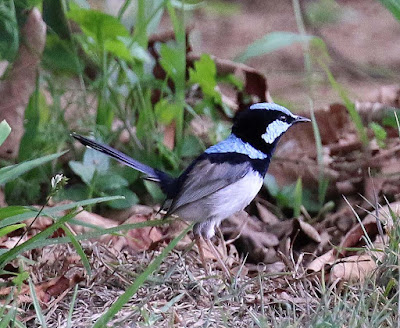 |
| A Superb Fairy Wren at Guanaba Park. |
 |
| A Richmond Birdwing Butterfy had Isha all of a flutter. |
 |
| A Noisy Pitta on Mt Tamborine. |
 |
| Isha seeking the difficult shot at Cameron Falls. |
 |
| A Wompoo Fruit Dove nesting above the Knoll Track. |
 |
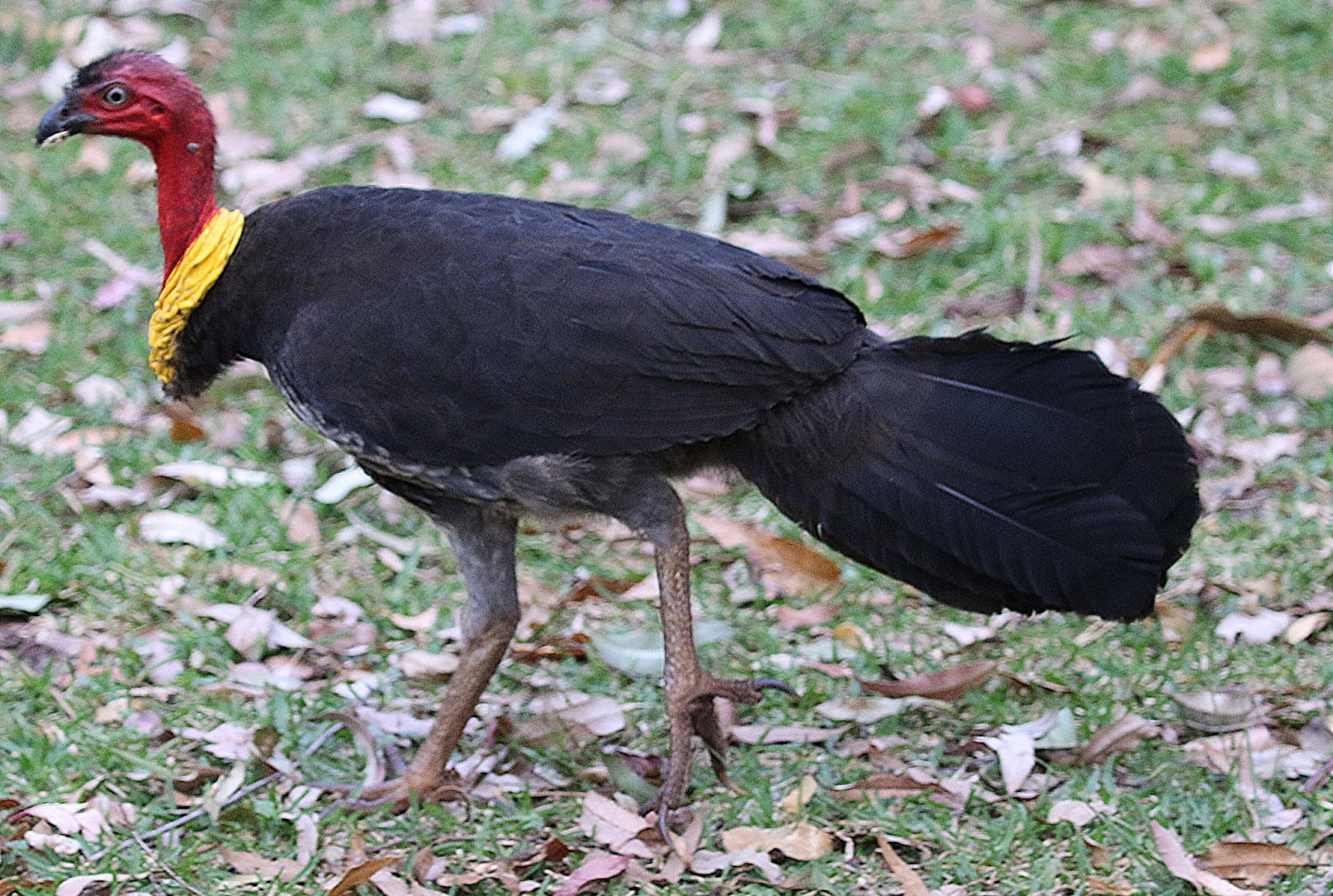
| Brush Turkeys kept chasing Isha and were renamed 'Velociraptors'. |
 |
| King Parrots at the feeders. |
 |
| Swamp Wallaby and Joey at Coombabah Wetlands. |
 |
| Koala dozing in the sun. |
 |
| Grey Kangaroos lurking in the forest at Coombabah |
 |
| Raptors over the river. |
 |
| White-faced Heron, Australian Ibis and Curlew on the Coomera Rover at Coombabah. |
 |
| Brahminy Kite |
 |
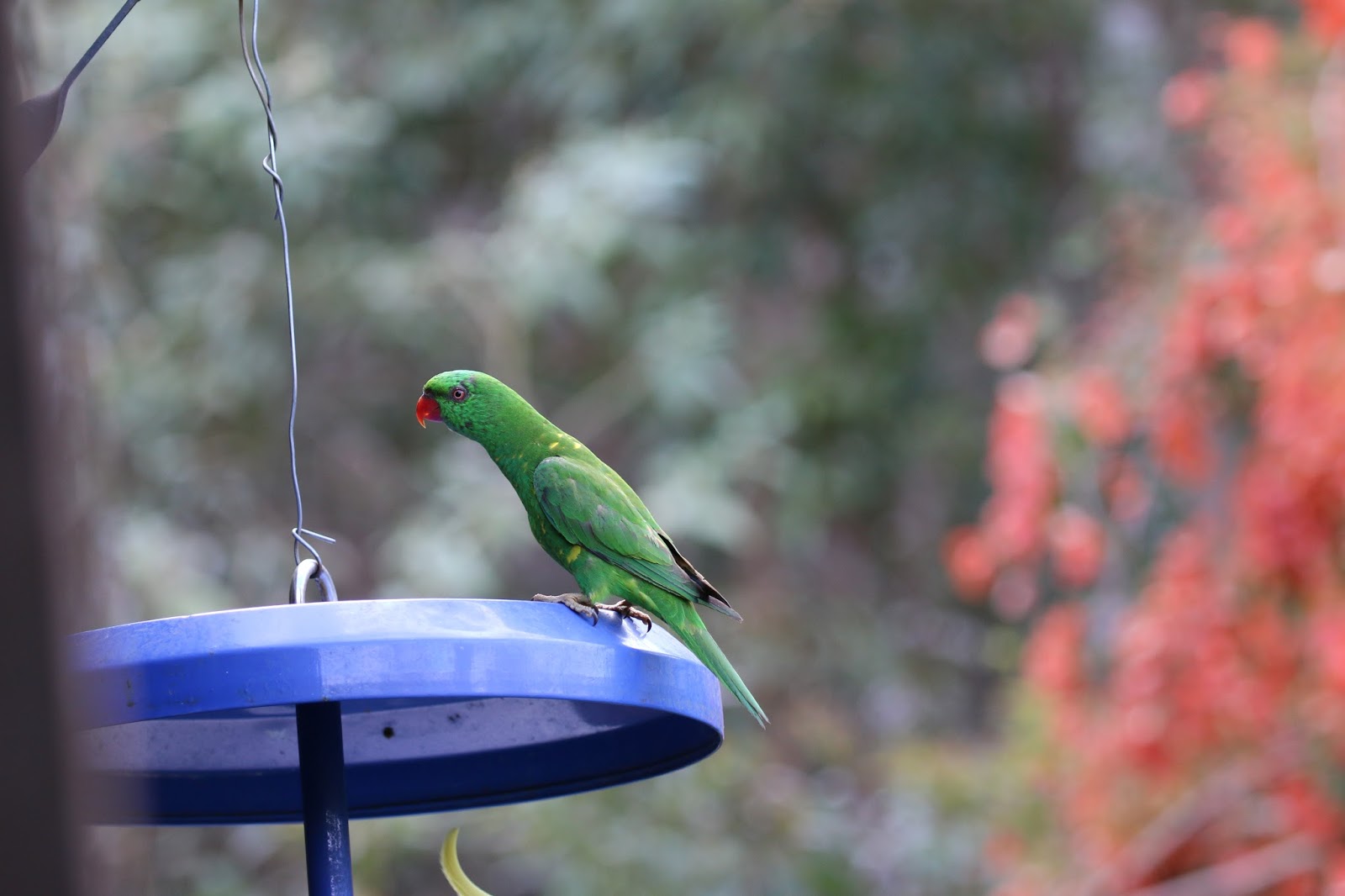
| Scaly-breasted Lorikeet at the feeder. |
 |
| Juv. Fant-tailed Cuckoo at Ngarangwal |
 |
| Even the flies can be brightly coloured over here. |
 |
| Echidna found by Isha at Ngarangwal. |
 |
| Paradise Riflebird at O'Reilly's. |
 |
| Regent's Bowerbird at O'Reilly's. |
 |
| Red-necked Pademelon at O'Reilly's. |
 |
| Brown Thornbill at the falls. |
 |
| A type of Harlequin beetle. |
 |
| Baby Noisy Miner and parents. |
 |
| Pied Cormorant off the Spit. |
 |
| Crested Tern off the Spit. |
 |
| Pelican awaiting feeding time on the Broadwater. |
 |
| Nesting Australian Ibis at Waterhen lake. |
 |
| Straw Necked Ibis at Waterhen lake. |
 |
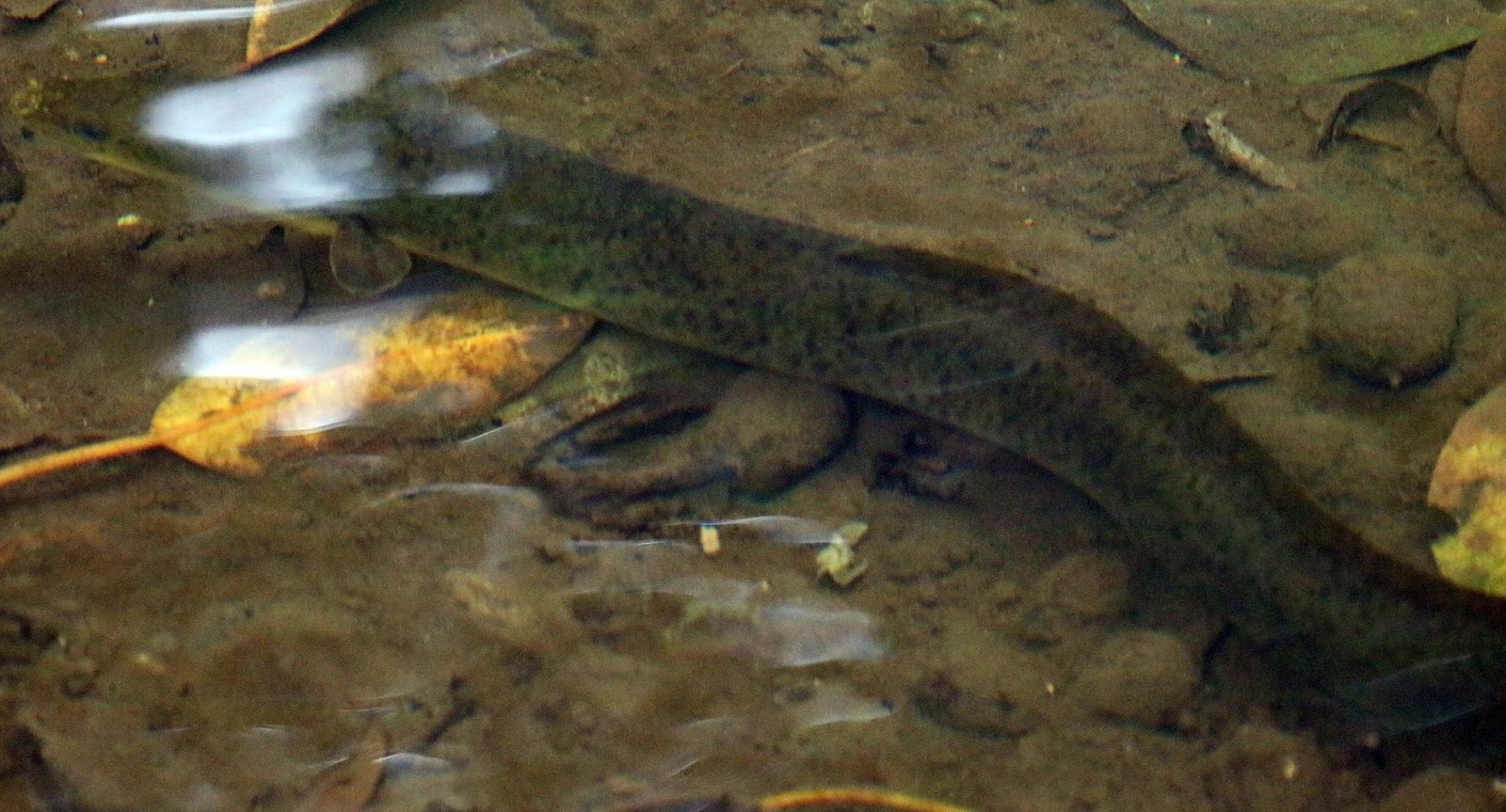
| An eel in the water at Natural Bridge |
 |
| Satin Bowerbird at Natural Bridge picnic area. |
 |
| An Osprey lifts off from his nest at Kingscliffe. |
Meanwhile, back at the Holt we've had a problem with an algae bloom on the Back Dam that doesn't seem to have affected the wildlife, but has turned the water bright green. Having my brother Pete available opened up new options as he's an expert on pumps and things (he's an oil rig project manager). I had obtained a poison called Coptrol that will kill the algae and nothing else, BUT, when the algae dies it removes the oxygen from the water thereby killing the fish. They way round this is to oxygenate the water and I was coming up with plans involving an air pump and a lot of reticulation hosing, when Pete suggested a filter.
 |
| Pete the mad inventor at work. |
Pete took an old pallet that we stuffed with polystyrene and wrapped in hessian to form a raft. The next components included a submersible pump, a solar panel, a sack of shell grit, some lengths of tubing, three unwanted juice containers and a flowerpot.
 |
| Pete removed the spigots and connected the juice containers with the tubing and the pump and then filled the containers with the grit. |
As the water passes through the shell grit and hessian sacking it will filter the algae and add calcium carbonate to the water, which can help against the algae. It will also oxygenate the water to some extent.
 |
| The water now pumps up through the gravel and then drains back into the dam through the hessian sacking. |
OK, it's not the prettiest island in the world, but I intend to plant some water loving mosses on it to pretty it up.
 |
| and the flowerpot...to provide Schnappy the Turtle with some greenery. |
Will it be effective, who knows? It's been pumping away for a couple of weeks now and the water colour is changing, become a less luminous green, so I'm keeping the poison locked away for the time being.
Now, it must be time for the birds:
Regulars (Seen at list x5 per week)
Bar-shouldered Dove
Common Bronzewing
Double-barred Finch
Galah
Laughing Kookaburra
Little Corella
Noisy Friarbird
Olive-backed Oriole
Pacific Black Duck
Peaceful Dove
Pied Butcherbird
 |
| An Australian Magpie watching his cousin, the Pied Butcherbird, sing. |
Pied Currawong
Plumed Whistling Duck
Rainbow Lorikeet
Scarlet Honeyeater
Silvereye
 |
| Silvereye in the Grevilleas. |
Sulphur-Crested Cockatoo
Torresian Crow
Welcome Swallow
White-throated Gerygone
Yellow-faced Honeyeater
Common (Seen at least x2 per week)
Black-faced Cuckoo Shrike
Brown Honeyeater
 |
| A Brown Honeyeater |
King Parrot
Lewins Honeyeater
Little Friarbird
 |
| A Little Friarbird |
Noisy Miner
Striated Pardalote
Yellow-tailed Black Cockatoo
Uncommon (Seen 2-5 times in the month)
Australian Magpie
 |
| Maggie has been away nesting. |
Brown Cuckoo Dove
Fan-tailed Cuckoo
 |
| A Fan-tailed Cuckoo |
Figbird
Golden Whistler
Litte Friarbird
Pale-headed Rosella
Scaly-breasted Lorikeet
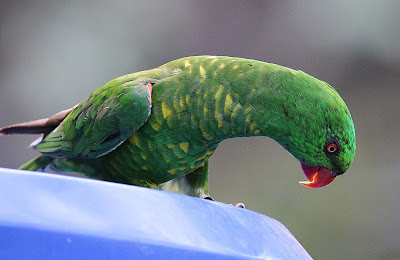 |
| Scaly-breasted Lorikeet on a feeder. |
Wedge-tailed Eagle
White-naped Honeyeater
White-throated Honeyeater
 |
| White-throated Honeyeater |
White-throated Treecreeper
Wood Duck
Yellow-tailed Black Cockatoo
Rare (Seen only once in the month)
Brown Goshawk
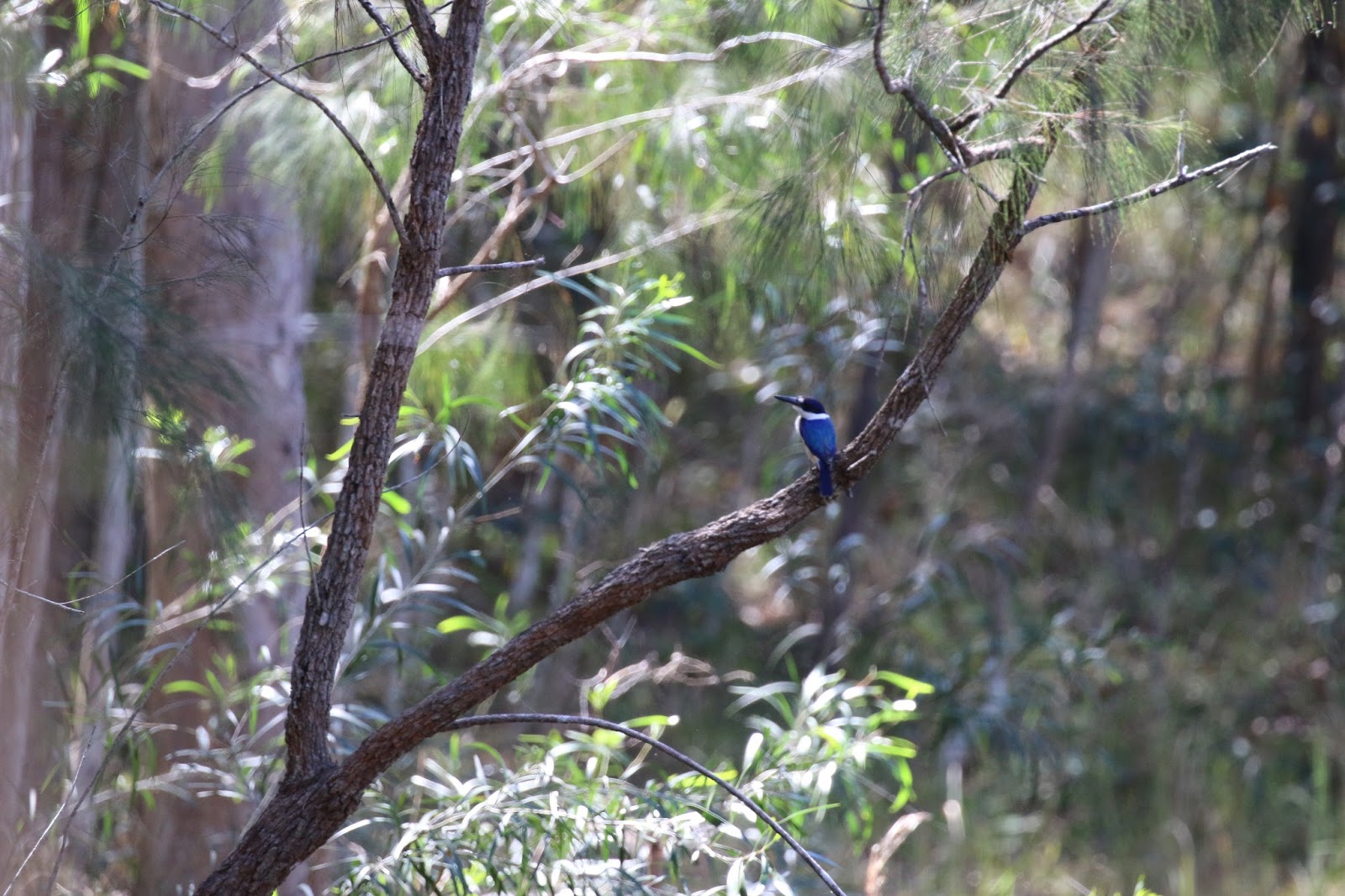
Forest Kingfisher
Leaden Flycatcher
Little Bronze Cuckoo
Little Eagle
Masked Plover
Pheasant Coucal
Red-browed Finch
White-bellied Sea Eagle
Which is 52-species, way off previous years, but explained by being away from the Holt so much (I hope).